Teiji
The Earthquake BirdTeiji is a photographer and restaurant worker whose camera makes him at once intimate and difficult to know. Lucy first sees him in the rain, bent over a puddle outside the Keio Plaza Hotel; later, his photographs connect her to Lily and become part of the evidence that clears Lucy while leaving Teiji’s own role unresolved. The reader encounters him largely through Lucy’s memories and interpretations, so his deliberate silences and her imaginative projections remain difficult to separate.
Identity and Background
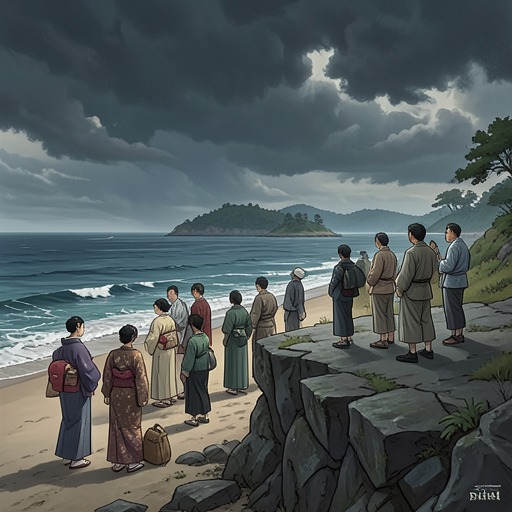
Teiji grew up near Kagoshima, in southern Kyushu, within sight of Sakurajima, an active volcano whose smoke and rumbling seemed ordinary to him as a child. He rode an old bicycle through the countryside, carrying rice balls prepared by his mother in his pockets. For his first day of junior high school, his father gave him a camera; Teiji took it on his rides and photographed the volcano from different angles.
Water became another enduring subject. As a boy, Teiji waded at the sea’s edge and photographed his toes beneath the rippling surface, testing whether water would appear in a picture as it did in life. He compared developed photographs with the reality before him, sometimes unable to tell which was which. Lucy recalls that he eventually forgot the volcano, though it remained visible in the distance. These childhood experiments anticipate the adult photographer’s attention to surfaces, reflections, and the gap between an image and what it can establish.
By the time Lucy knows him, Teiji is living in Tokyo and working shifts at his uncle’s noodle shop. His small room is crowded with clothes, books, CDs, several cameras, and two cardboard boxes filled with camera-shop envelopes. The walls are bare, with no photographs displayed. Lucy knows that the boxes hold years of images, but Teiji has shown her only some pictures containing her; the photographs from before their relationship remain private.
First Meeting and Life with Lucy
Lucy meets Teiji while wandering through Tokyo after the string quartet she had played in with Mrs. Yamamoto disbanded, leaving her Sundays unstructured. In the rain around Nishi-Shinjuku, she notices him photographing a puddle outside the Keio Plaza Hotel. He shifts around the water with his camera to his eye, apparently absorbed in the reflection of the hotel. Lucy steps into the puddle’s edge; Teiji includes her feet in the photograph, then looks at her through the viewfinder and takes the first pictures of her. She never sees those images.
Lucy remembers their departure together as nearly wordless. They walk from the tall buildings into the narrower streets of Shin-Okubo and go to Teiji’s apartment. There, he takes one final photograph of her, naked and kneeling on the bed. Lucy says the camera felt kinder than a naked eye because it could not blink or sneer as the picture was taken. Her account makes photography part of their intimacy, but also gives Teiji the power to frame and keep an image of her.
Their life together develops through quiet routines rather than extensive conversation. Lucy wanders along the Yamanote Line and meets Teiji in Shinjuku; they spend time in the noodle shop, where she reads Japanese novels while he serves customers or takes out rubbish. They also spend weekends in bed and go out together on warm, rainy nights. Teiji teaches Lucy words for different kinds of rainfall. In her recollection, the rainy season seems to persist through their time together, binding their romance to the weather of their first meeting.
Photography, Privacy, and Other Relationships
The camera is Teiji’s means of attending to the world, but his collection is not an open record for Lucy to inspect. After wondering about the two boxes in his room, she lets herself into his apartment with a spare key and searches through them. She looks past childhood photographs and recent pictures of herself, seeking the years between Teiji’s arrival in Tokyo and their meeting. In the older collection she finds images of a woman, first onstage in a soldier’s uniform and later at theaters, parties, cafés, and other places. The woman appears increasingly sad and disheveled; the last photograph Lucy sees shows her lying on the pavement. Lucy wonders whether this was Teiji’s lover, but the images do not tell her the woman’s identity or explain what happened to her. When Teiji finds Lucy looking, he says, “They’re private.” His rebuke marks a boundary that her sense of familiarity with his room had led her to cross.
Lucy also introduces Teiji to Lily at the noodle shop. He photographs the two women together while Lily eats; later he gives the print to Lucy, wrapped in carefully folded newspaper. Lucy keeps both the photograph and its wrapper. She is pleased that Teiji gave her the picture rather than Lily, and interprets this as meaning that the image is of Lucy with Lily as an addition, not of two friends presented as equals. She knows Lily might have wanted a copy, but does not have it made. In retrospect, Lucy treats the shutter’s click as the beginning of trouble: the image itself shows only the two women at a table, while the act of taking and possessing it acquires a darker meaning in her memory.
During a later night-long walk around Tokyo, Lucy passes places associated with Teiji and wonders whether the woman in the old photographs was Sachi. She imagines that Teiji might have moved from Sachi to Lucy and then from Lucy to Lily, like successive stations along a track. This is Lucy’s conjecture, not a confirmed account of Teiji’s relationships. The route makes past and present overlap, but it cannot fill the gaps in what Teiji has told her.
The Photographs and the Unresolved Case
After Lily’s murder, two photographs reach the police in an envelope following newspaper coverage of Lucy. One shows Lily at a McDonald’s near Lucy’s home on the night of the murder, two hours after Lily was seen at Lucy’s front door. A cashier recalls Lily with a Japanese man; the pair seemed distressed, and Lily left her cheeseburger untouched but drank her Coke. The other photograph shows a woman confined between close brown walls, her head lolling and her eyes empty. The police do not know who took the photographs. Lucy believes Teiji did.
The first image changes the case because it places Lily with another person after she left Lucy’s home. Along with the absence of fingerprints or DNA linking Lucy to Lily’s body, it contributes to the police decision to release Lucy without charges. Yet the photographs do not identify the Japanese man or prove who killed Lily. Lucy considers whether Lily might have told Teiji their relationship was over, and whether he could have wanted to remove Lily and return to Lucy, but she does not claim to know his motive. She explicitly recognizes that the evidence is circumstantial and that the pictures clear her without proving Teiji guilty.
Narrative Role and Significance
Teiji’s character is built around a tension between seeing and withholding. He photographs puddles, Lucy, and the women around him, yet keeps the archive of his life out of Lucy’s reach. His pictures can preserve an encounter, as with the first image of Lucy’s feet in the puddle or the later photograph of Lucy and Lily at the noodle shop; they can also invite interpretations that exceed what their contents establish. The sealed boxes make his past materially present while denying Lucy a reliable explanation of it.
That tension persists at the novel’s close. Teiji’s photographs help dislodge the case against Lucy, but they do not settle the question of his responsibility for Lily’s death. Lucy’s attachment makes her both a close observer of Teiji and an unreliable interpreter of his silences: she can identify what she believes his camera recorded, while continuing to speculate about the person behind it. Teiji therefore remains not simply the object of Lucy’s memories but the unresolved point where intimacy, possession, and proof meet.